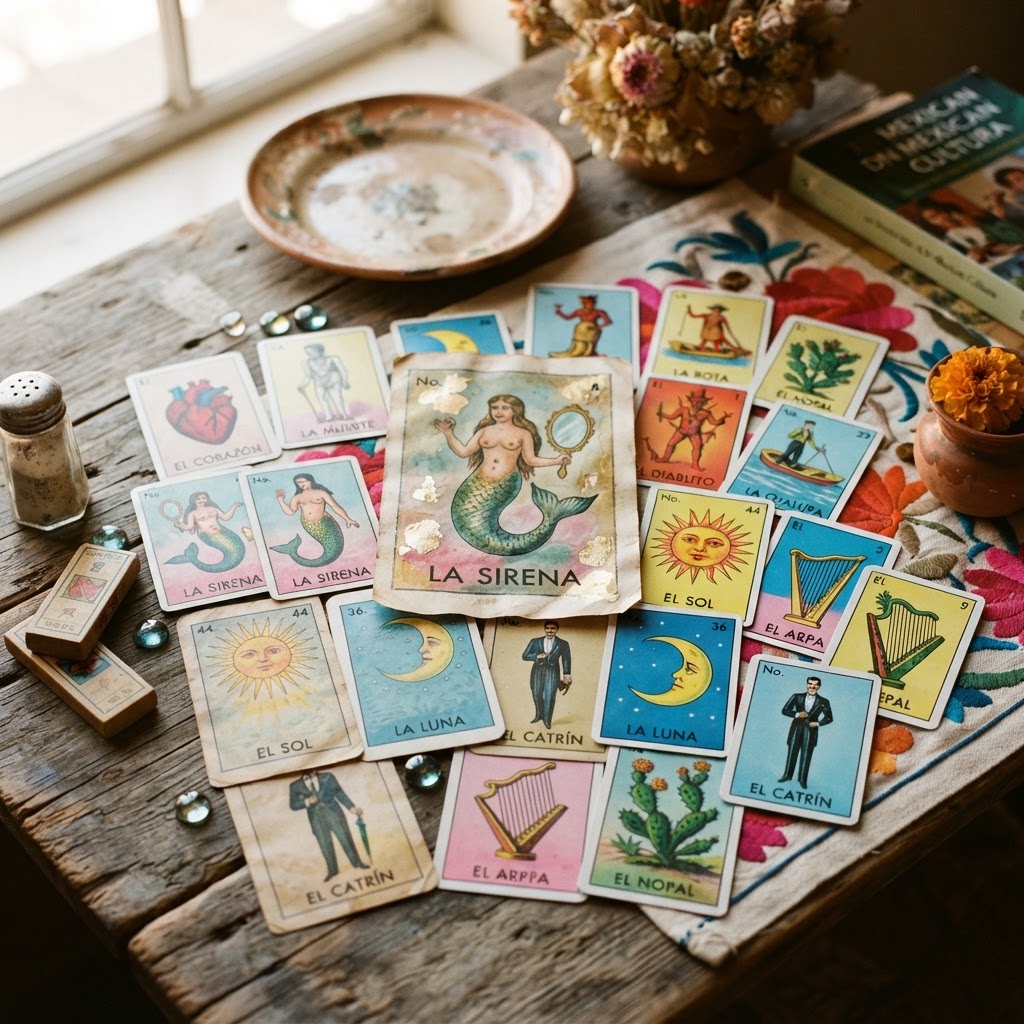
What Is Lotería?
Lotería is a traditional Mexican game of chance played with a deck of illustrated cards and a set of tablas — playing boards similar to bingo cards. A caller, known as the cantor or gritón, draws cards one at a time and announces each one, often reciting a riddle, poem, or rhyme instead of simply naming the image. Players mark the matching image on their tabla using beans, bottle caps, coins, or small stones. The first player to complete a predetermined pattern — a row, column, or full board — shouts "¡Lotería!" to claim the win.
At its core, Lotería cards are a visual language. Each card in the traditional deck depicts a person, animal, object, or concept drawn from Mexican everyday life, folklore, and cultural imagination. The images are bold, colorful, and immediately recognizable — a rooster, a mermaid, a skull, the sun — and they carry layers of meaning that stretch far beyond their role as game pieces. For millions of families across Mexico and the Mexican diaspora in the United States, Lotería is not simply a pastime. It is a ritual, a reunion, and a living piece of cultural memory played at kitchen tables, birthday parties, fiestas, and holiday gatherings.
If you have ever wondered about the Lotería cards meaning behind each image, or why this game holds such a powerful place in Mexican culture, this guide will walk you through the full story — from the game's surprising European roots to the iconic deck most people recognize today.
The History of Lotería: From Italy to Mexico
The story of Lotería is a story of migration — of a European parlor game traveling across an ocean, taking root in colonial soil, and eventually becoming something entirely its own.
European Origins
The earliest known ancestor of Lotería was a number-based lottery game that emerged in Italy in the 15th century. By the late 1400s, a similar game called Il Gioco del Lotto d'Italia had become a popular form of state lottery. As these games spread through Europe, illustrated picture cards began replacing numbers, making the game accessible to players who could not read. France and Spain adopted their own versions during the 16th and 17th centuries, using decks of printed images to teach vocabulary, morality, and social hierarchy through play.
Spain brought this illustrated card game to the Americas during the colonial period, where it would undergo its most significant transformation.
Lotería in Colonial Mexico
The game arrived in New Spain — present-day Mexico — during the late 18th century, around 1769. At first, it was a leisure activity enjoyed primarily by the Spanish colonial aristocracy and upper classes. Public fairs and traveling carnivals began incorporating Lotería as a ticketed game of chance, slowly opening it to a broader population. As the game moved into mestizo and indigenous communities, the imagery on the cards began to shift. Rather than reflecting purely European iconography, the illustrations evolved to include figures and symbols rooted in Mexican daily life, landscape, and popular belief.
By the 19th century, Lotería had become a genuinely popular game across social classes, played in markets, plazas, and homes throughout the country. Its identity was no longer European — it was Mexican.
The Don Clemente Jacques Era
The version of Lotería that most people recognize today was standardized and popularized by Don Clemente Jacques, a French-born entrepreneur who emigrated to Mexico and built a successful food and goods company. In 1887, his company produced what would become the most iconic and enduring edition of the Lotería deck. The bold illustrated cards with their clean black outlines and vivid colors — printed under the Pasatiempos Gallo brand — became the de facto standard for the game across Mexico.
The Don Clemente deck established the 54 traditional Lotería cards that most players know by heart, and its visual style has remained largely unchanged for over a century. That consistency is itself a cultural statement: these images have become so embedded in Mexican visual culture that they appear in murals, tattoos, fine art, fashion, and political commentary far beyond the game table.
The 54 Traditional Lotería Cards and Their Meanings
One of the most common questions people ask is: what are the 54 Lotería cards? The traditional deck contains exactly 54 illustrated cards, each assigned a number and a name. Together they form a kind of portrait of Mexican cultural life — its landscapes, its people, its creatures, its values, and its relationship with death and the divine.
Here is a look at some of the most iconic cards and the cultural symbolism they carry:
- El Gallo (The Rooster) — #1: The opening card of the traditional deck. The rooster represents pride, dawn, masculinity, and the start of something new. It is one of the most recognized symbols in Mexican rural life.
- La Sirena (The Mermaid) — #4: A figure of mystery, beauty, and dangerous allure. La Sirena draws on deep currents of Latin American folklore and reflects the complex relationship between desire and the unknown.
- El Catrin (The Dandy) — #9: A well-dressed gentleman figure representing style, urbanity, and social aspiration. He is sometimes read as a satirical commentary on class pretension.
- El Paraguas (The Umbrella) — #11: A practical object elevated to symbol — representing shelter, protection, and the small dignities of everyday life.
- El Sol (The Sun) — #24: One of the most powerful cards in the deck. The sun represents life, energy, warmth, and the divine force that sustains the natural world. In Mexican cosmology, the sun carries immense spiritual weight rooted in pre-Columbian belief systems.
- La Luna (The Moon) — #25: Companion to El Sol, La Luna is associated with femininity, cycles, mystery, and the night. Together, the sun and moon form one of the deck's most symbolically rich pairings.
- La Corona (The Crown) — #26: A symbol of honor, achievement, and authority.
- El Corazón (The Heart) — #27: Love, courage, and emotional truth. The heart card is one of the most universally understood images in the deck and one of the most frequently referenced in popular Lotería iconography.
- La Sandía (The Watermelon) — #28: A beloved fruit in Mexican summer culture, representing abundance, sweetness, and the pleasures of the ordinary.
- El Tambor (The Drum) — #34: Music, rhythm, and celebration — core elements of Mexican communal life.
- La Muerte (Death) — #36: Perhaps the most culturally significant card in the deck. Unlike Western traditions that treat death as something to be feared and avoided, Mexican culture — shaped in part by pre-Columbian Aztec and Mayan beliefs and reflected in celebrations like Día de los Muertos — frames death as a natural part of the cycle of life. La Muerte is not a figure of horror; she is a familiar presence, sometimes even a friend.
- El Árbol (The Tree) — #44: Strength, rootedness, ancestry, and the passage of time.
- La Rosa (The Rose) — #50: Beauty, love, and the brevity of life in full bloom.
- La Chalupa (The Canoe) — #54: The final card in many traditional decks, the chalupa references the trajineras — the iconic flat-bottomed boats of Xochimilco in Mexico City — and evokes journeys, both literal and metaphorical.
The full 54-card deck also includes animals such as El Venado (the deer), El Alacran (the scorpion), and El Camarón (the shrimp); human figures like La Dama (the lady), El Borracho (the drunk), and El Soldado (the soldier); and objects from daily life including La Escalera (the ladder), La Campana (the bell), and El Violín (the violin). Taken together, they form a miniature encyclopedia of a world.
As for the question of what's the best card in Lotería — that depends entirely on who you ask. Many players have deep personal affinities for particular cards. La Sirena is a perennial favorite for its visual drama. El Sol is beloved for its symbolism. And La Muerte, with her quiet power, has become one of the most artistically reimagined cards in contemporary Lotería culture. The "best" card is ultimately the one that means the most to you.
How Lotería Is Different From Bingo — and From Tarot
Lotería is often described as "Mexican Bingo," and while the comparison captures the basic gameplay mechanic, it misses almost everything that makes Lotería culturally distinctive.
In standard Bingo, numbers are called randomly from a hopper and matched to a grid. There is no imagery, no storytelling, and no cultural content — it is a pure game of chance. Lotería, by contrast, uses illustrated cards rich with symbolism and meaning. The cantor rarely simply announces a card by name; instead, they call it through a verso — a traditional riddle or rhyme that the players must decode. For example, "El que con la cola pica" might be called for El Alacran (the scorpion), or "No hay mal que por bien no venga" for another card. This layer of wordplay, wit, and cultural knowledge transforms the game from a passive number-matching exercise into an active, communal, and often hilarious experience.
A more interesting comparison — and a genuine PAA question that many people search — is whether Lotería is like tarot cards. The honest answer is: not really, though the comparison is understandable. Both use illustrated cards with symbolic imagery, and both have inspired rich artistic interpretation. But tarot is a system of divination with a fixed symbolic grammar designed to be read as a narrative about a person's inner life or future. Lotería is a game of chance; its cards are not read in combination or interpreted for personal meaning in the same way. The similarities are aesthetic and cultural rather than functional. That said, some contemporary artists and scholars have explored the symbolic resonances between the two systems, and the Lotería deck's rich imagery does lend itself to reflection and interpretation — which is part of why it has endured so powerfully as a cultural artifact.
How Lotería Is Played: Traditional Rules
Traditional Lotería is simple to learn and endlessly replayable. Here is how a standard game works:
- Setup: Each player receives one or more tablas — boards printed with a 4×4 grid of 16 images drawn from the 54-card deck. Each tabla has a different combination of images.
- The caller: One person serves as the cantor, shuffling the 54-card deck and drawing cards one at a time.
- Calling the card: The cantor announces each card — by name, riddle, or rhyme — and all players scan their tablas for the matching image.
- Marking: When a player finds a matching image, they place a marker on it. Traditionally, dried pinto beans are used, though coins, bottle caps, and small stones are common.
- Winning: The first player to complete a full row, column, diagonal, four corners, or full tabla — depending on which pattern was declared before the game — shouts "¡Lotería!" and wins the round.
- Prize: In casual family play, the winner might receive bragging rights or a small treat. In more formal settings, players contribute to a pot before the game begins.
Part of what makes Lotería so beloved is its flexibility. The game scales effortlessly from two players to twenty, requires no electricity or special equipment, and creates space for laughter, teasing, and storytelling through the caller's versos.
Modern Lotería: From Tradition to Personal Expression
Over the past few decades, Lotería has experienced a remarkable cultural renaissance. The iconic imagery of the Don Clemente deck has become a touchstone for Mexican and Mexican-American artists, designers, activists, and communities. The cards appear in gallery installations, street murals, embroidery, political posters, and high fashion. Chicano and Latinx artists have reinterpreted the deck to reflect queer identity, immigrant experiences, environmental concerns, and contemporary political realities. Each reimagining is both an homage and a conversation — an assertion that this visual language is alive and capable of carrying new meaning.
Custom and personalized Lotería decks have also become a cherished tradition in their own right. Families create decks featuring photos of relatives, inside jokes, and beloved pets. Teachers build classroom decks to teach vocabulary in Spanish and English. Community organizations design decks that celebrate local history and culture. The practice of making your own Lotería deck is not a departure from tradition — it is an extension of it. The game has always been a mirror of the community that plays it. Making it personal simply makes that mirror more precise.
This impulse to personalize connects directly to what Lotería has always been: a game that belongs to its players. The images in the traditional deck were themselves a reflection of the world as ordinary Mexican people experienced it — their landscapes, their neighbors, their humor, their fears. Creating a custom deck is an act of cultural participation, not cultural appropriation. It honors the form by filling it with new life.
To explore more of the cultural history and traditions that inspire our work, visit our articles archive, where we continue to build a growing library of educational resources on Lotería and Mexican cultural heritage.
Creating Your Own Lotería Cards Today
Understanding the Lotería cards meaning and the deep history behind this game makes the act of creating your own deck feel like what it truly is: participation in a living tradition. Whether you want to celebrate a family reunion, honor a community milestone, design a teaching tool, or simply create a one-of-a-kind keepsake, the tools to do it have never been more accessible.
At Modern Lotería Studio, we built our platform specifically for people who want to create custom Lotería cards with care and intention. Our Deck Editor gives you full control over your imagery, card names, and deck design — so you can create something that is genuinely yours while honoring the visual tradition that inspired it. You can upload your own photos, customize the layout, and produce a complete playable deck with all the charm of the classic game.
When your custom deck is ready, you can order professional-quality printed cards directly through our store, delivered to your door and ready to play at your next gathering. From quinceañeras to classroom games to family reunions to corporate events, a custom Lotería deck is both a meaningful gift and a lasting artifact of the moments and people that matter to you.
The tradition of Lotería has survived centuries, crossed oceans, and adapted to every era it has passed through — because it belongs to the people who play it. That includes you.


