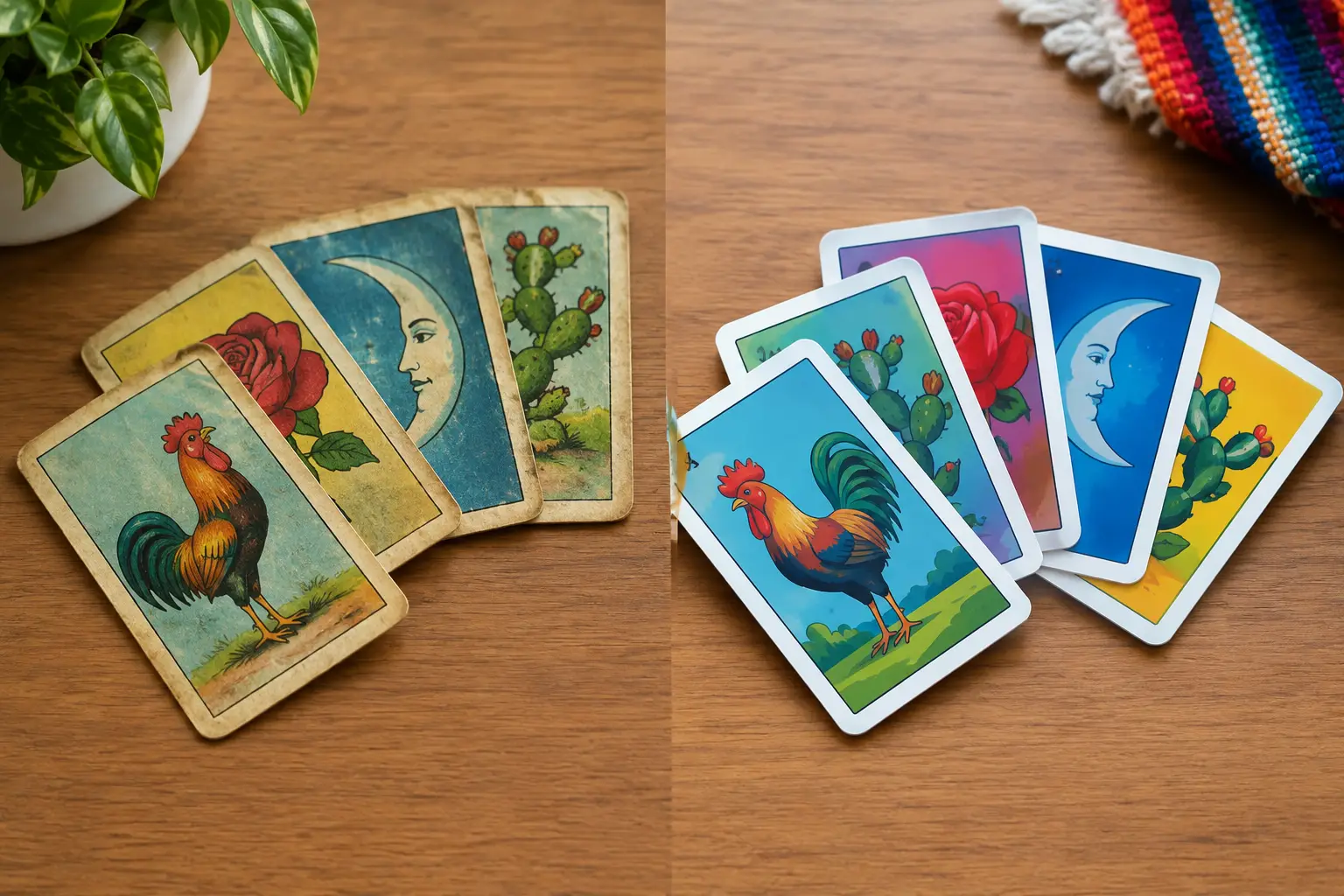
A Lotería card can make a whole room react before anyone calls the next image. Someone spots El Corazón and remembers playing at their grandmother’s table. Someone else sees a cousin turned into a cartoon character and immediately laughs. That is the real difference in traditional versus modern Lotería cards: both create connection, but they do it through different kinds of recognition.
Traditional decks carry a visual language generations know by heart. Modern decks keep the satisfying rhythm of the game while making space for the people, jokes, milestones, and communities gathered around the table. Neither approach is automatically better. The right one depends on what you want the game to hold onto and what you want it to say right now.
What traditional Lotería cards preserve
Classic Mexican Lotería is more than a matching game. Its familiar imagery, including La Sirena, El Árbol, El Sol, and El Diablito, creates a shared cultural shorthand. Each card has a name, a personality, and often a memory attached to it. Players may remember a particular caller’s dramatic voice, beans scattered across a tabla, or the excitement of filling a row before everyone else.
The visual style matters, too. Traditional cards often use bold colors, expressive figures, decorative borders, and instantly recognizable compositions. Even people who have not played recently can identify many cards at a glance. That recognition makes a traditional deck especially powerful for family gatherings where multiple generations will be playing together.
A classic deck also offers continuity. For Mexican American and Latinx families, it can be a way to keep a beloved tradition visible at birthdays, holidays, reunions, and Sunday dinners. For multicultural families and guests new to the game, traditional cards provide a welcoming introduction to an iconic format with real history behind it.
There is a practical advantage as well: no setup is needed beyond opening the box. The established card set means everyone is playing from the same visual vocabulary. If your goal is a familiar, low-effort game night, traditional Lotería delivers that beautifully.
Where traditional decks can feel limiting
Familiarity is a strength, but it can also be the boundary. A standard deck cannot show the newlyweds, the birthday guest of honor, a beloved abuela, the family dog, or the inside joke that only your friend group understands. It can celebrate Lotería itself, but it cannot automatically tell the story of your specific event.
That distinction matters when the game is part of a larger occasion. At a wedding shower, a custom card labeled La Bride may get more cheers than a standard image ever could. At a graduation party, cards featuring the graduate’s favorite snack, school mascot, roommates, and proud relatives can turn a quick activity into a keepsake.
Traditional imagery also comes with cultural context. When using a classic deck, it is worth honoring the game as a Mexican tradition rather than treating it as generic party decor. A thoughtful host can introduce the game, pronounce card names with care, and let the deck’s history be part of the fun. Customization should not erase that foundation. It can build on it.
Traditional versus modern Lotería cards: the real shift
Modern Lotería cards do not need to abandon the structure people love. Players still listen for a call, search their tablas, mark a match, and celebrate when they complete the winning pattern. The shift is in the images and language that fill that structure.
Instead of La Dama, a card might feature Aunt Rosa in her favorite red lipstick. Instead of El Gallo, it might be your friend’s rooster-shaped coffee mug. Instead of a universal symbol, the card can become a tiny portrait of a person, place, food, pet, business, or memory that matters to your group.
This makes modern decks feel immediate. They are built for a particular audience, not an imagined average player. A family reunion deck can include childhood homes, nicknames, legendary recipes, and relatives who live across the country. A baby shower deck can include ultrasound photos, nursery colors, and the parents’ favorite things. A community fundraiser deck can spotlight local landmarks and small businesses.
The format stays recognizable, but the experience becomes personal. That is why custom Lotería often gets people talking between rounds. Every card invites a story: “Remember when that happened?” “That was your first apartment!” “Why is the dog wearing sunglasses?” A deck becomes entertainment and a conversation starter at the same time.
What makes a modern deck work
Personal does not have to mean messy. A successful custom deck has a clear visual system, readable card names, and images that remain easy to recognize from across a table. If every card uses a different photo treatment, font, color palette, and joke style, the deck can feel more like a collage than a complete game.
Start with the event. For a wedding, you might choose photos of the couple, their shared routines, meaningful places, and favorite foods. For a family gathering, think about the people and references that will spark instant recognition across generations. For a business event, choose brand-friendly images that are still playful enough to keep the game social.
Then think about balance. Include obvious crowd-pleasers alongside a few deeper-cut references. A deck made entirely of private jokes may leave newer partners, children, or guests feeling left out. A deck with only polished portraits may look beautiful but miss the humor that makes people want to play twice.
Photo quality helps, but you do not need professional headshots for every card. Clear, well-lit images with one main subject are usually easiest to turn into strong artwork. Group photos can work when the group itself is the point, but tiny faces and busy backgrounds may become hard to read once printed at card size.
Modern Lotería Studio makes this workflow approachable: upload your photos, cartoonify them, customize the card text, and generate coordinated, print-ready cards and game boards. The goal is not to make every host become an illustrator or layout expert. It is to give your ideas a polished, playable form.
When to choose a traditional deck
Choose a traditional deck when the classic imagery is the occasion. It is a great fit for an easy family game night, a cultural learning activity, or a gathering where players want the shared comfort of familiar cards. It can also be the better choice when you need a game quickly and do not have the time to collect photos or plan custom details.
A traditional deck is especially meaningful when the people at the table have their own long relationship with it. Let the cards remain what they are: recognizable cultural icons with stories already attached. You can still make the moment feel special through food, music, a prize, or a caller who brings plenty of personality.
When a custom deck is worth it
Choose a modern, personalized deck when the people in the room are the main event. Weddings, milestone birthdays, reunions, retirements, holiday parties, classroom celebrations, and brand activations all benefit from details guests can recognize as their own.
Custom decks also shine as gifts. A deck created for grandparents can preserve family nicknames and faces in a format everyone can enjoy together. A deck for a best friend’s birthday can capture years of jokes without becoming another framed photo. For artists, organizers, and small businesses, it can turn a community story into a memorable, shareable activity.
The trade-off is planning time. You will need to choose images, review names, and make sure the deck includes enough variety to stay fun during play. But that creative effort is often exactly what gives the final piece its emotional weight.
You can honor the classic while making it yours
The best modern decks understand what makes Lotería feel like Lotería in the first place: bold images, memorable names, quick recognition, playful suspense, and a room full of people responding together. Customization works best when it respects those elements instead of burying them under complicated design.
You do not have to choose between heritage and originality. A deck can borrow the visual confidence of traditional Lotería while featuring your own family, friends, culture, humor, and milestones. Keep the cards clear. Give each one a name worth calling out loud. Choose images that make someone smile before the game even begins.
Whether you reach for the classic symbols or build a deck around your own, the most memorable card is the one that makes everyone at the table say, “That is so us.”