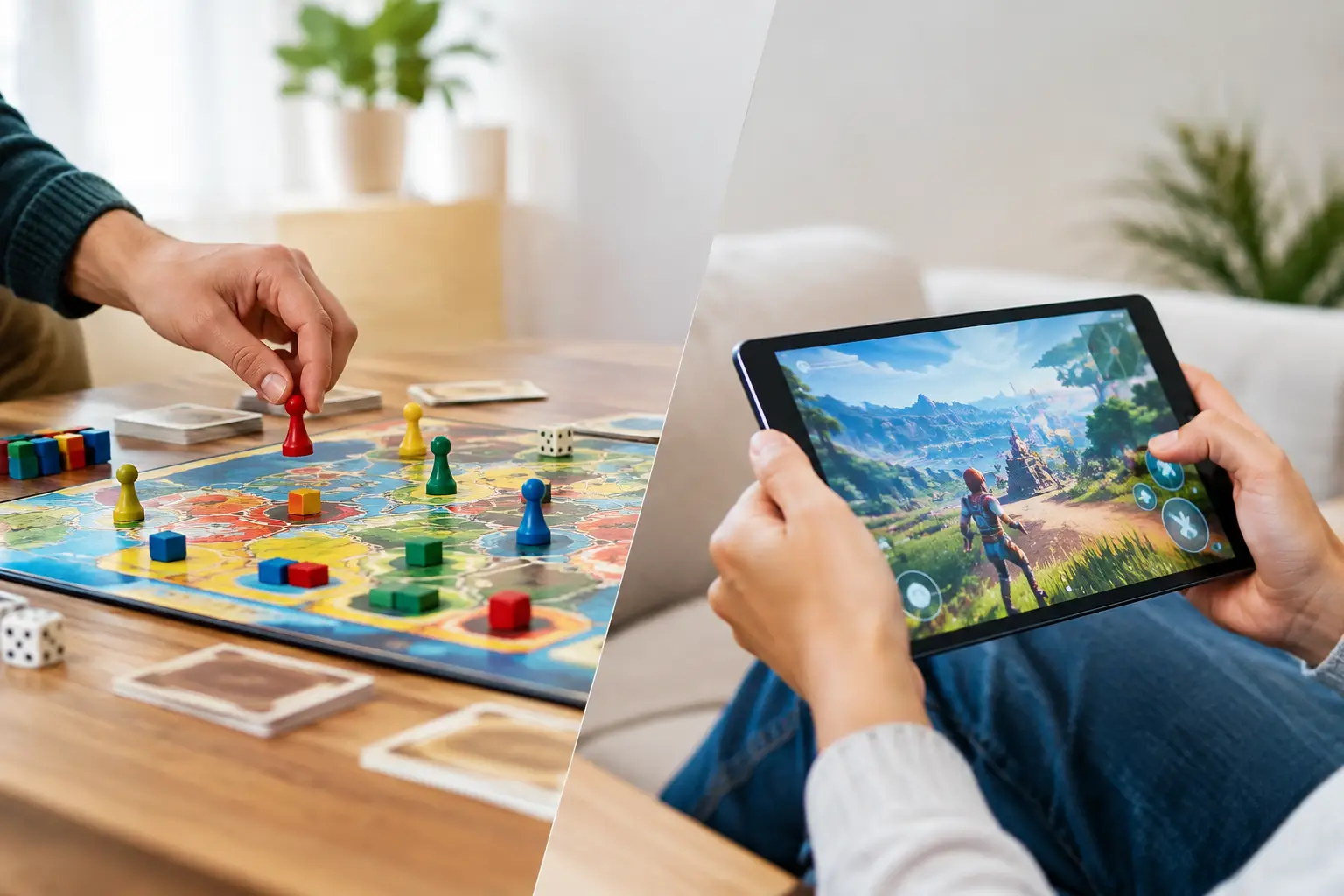
A phone can hold everyone’s attention for a few minutes. A game board covered in familiar faces can hold a room’s attention for an entire evening. When choosing printed games versus digital activities, the better option is not always the newest one. It is the one that gives your guests a reason to look up, laugh together, and feel part of the moment.
For a birthday, wedding shower, family reunion, classroom, or community gathering, the choice shapes more than entertainment. It affects how people participate, what they remember, and whether the activity feels like something made for them or simply placed in front of them.
Printed Games Versus Digital Activities: The Real Difference
Digital activities are fast to share, easy to update, and familiar to nearly every guest with a phone. A virtual trivia round, slideshow quiz, or online poll can be useful when people are in different places or when an organizer needs a low-cost activity with minimal setup. They work especially well for remote teams, long-distance families, and events that already rely on screens.
Printed games create a different kind of energy. Players hold cards, scan a game board, listen for a call, and react to the people around them. There is no notification competing for attention and no awkward pause while someone searches for a password or downloads an app. The game has a physical presence, which helps turn a short activity into part of the celebration itself.
That difference matters when your goal is connection rather than convenience alone. A printed Lotería deck featuring relatives, inside jokes, favorite foods, pets, or wedding-party nicknames invites people into the story behind the event. It gives guests something to talk about before the first card is even called.
Why Printed Games Feel More Personal
A screen can display a photo, but a printed game can make that photo part of a shared ritual. When Grandma becomes La Abuela, the family dog becomes El Perrito, or a couple’s first vacation becomes a card in a custom deck, the game becomes a collection of tiny recognitions. Players do not just try to win. They point, explain, tease, and tell the stories behind each image.
That is especially powerful for multicultural families and communities that want entertainment to reflect who is actually in the room. Traditional Lotería is already built around memorable images, lively calling, and group participation. Personalizing that familiar format can honor its recognizable structure while making room for your own family language, humor, and traditions.
Printed pieces also make personalization visible. Guests can see the care that went into the cards and boards. A thoughtfully designed deck feels like an intentional part of the event decor, favor table, welcome bag, or classroom activity rather than an extra tab open on someone’s phone.
Where Digital Activities Have the Advantage
Digital does win in some situations. If guests are joining from multiple cities, an online activity may be the only practical way to play together in real time. Digital formats are also useful when you need last-minute changes, want to collect responses automatically, or expect a very large group that cannot easily share physical materials.
For educators and organizers, digital activities can also support quick knowledge checks and individual participation. A student can answer privately, and a facilitator can see results immediately. For a brand event, a QR code can make it easy to direct attendees toward a survey, giveaway, or sign-up form.
The trade-off is attention. Phones are multipurpose devices, so the game competes with texts, social media, cameras, and work messages. Some guests may enjoy the convenience, while others may feel left out by unfamiliar technology, limited data, or a dead battery. The more an activity depends on every person using the same device and platform, the more likely small technical issues will interrupt the fun.
Choose Based on the Experience You Want to Create
Start with one question: What do you want guests to do when the activity begins?
If you want people to settle into a shared table experience, printed games are usually the stronger choice. They are ideal for bridal showers, quinceañeras, birthdays, holiday parties, reunions, retirement celebrations, school family nights, and community fundraisers. They give people of different ages a simple way to play together without needing instructions that feel technical or intimidating.
If you want people to participate from wherever they are, digital activities may fit better. They can make distance feel smaller, particularly for virtual celebrations or distributed teams. A hybrid gathering can benefit from both: use a digital invitation, RSVP form, or photo collection process, then bring the finished memories into a printed game at the event.
For many celebrations, that hybrid approach is the sweet spot. Digital tools help organize the details. Print brings the people together.
The Practical Side: Setup, Cost, and Keepsakes
Printed games require a little more preparation, but that preparation can pay off long after the event. You need enough cards or boards for your players, a way to call the cards, and a plan for printing and cutting. Once those pieces are ready, however, the activity is simple to run. No Wi-Fi is required, no one has to create an account, and the game can begin as soon as guests sit down.
A personalized deck can also serve more than one purpose. Use it as a group activity during the party, then let guests take home cards or mini decks as favors. Save a full deck as a family keepsake. Bring it out again next year and watch how quickly it becomes a tradition.
Digital activities generally cost less to duplicate because there is no printing. But a low upfront cost is not the same as long-term value. A one-time online quiz may disappear when the event ends. A custom printed game can live on a coffee table, in a classroom game cabinet, or in a box of family memories.
For a polished result, the production process matters. Personal photos may need consistent cropping, readable text, and images that work at card size. Game boards need clear layouts so players can spot each image quickly. Modern Lotería Studio makes that workflow more approachable: upload photos, cartoonify them, customize the card text, and generate coordinated, print-ready cards and game boards without having to build every element from scratch.
Make a Printed Game Easy for Every Guest
The best printed games are easy to join, even for someone who has never played before. Keep the rules short and explain the win condition before the first call. If your group includes young children, older adults, or guests who are new to Lotería, choose images that are distinct and text that is easy to read.
Personalization should add delight, not confusion. Mix highly specific cards, such as a cousin’s nickname or a favorite family recipe, with recognizable images that anyone can understand. If you are creating a deck for a wedding or work event, include enough shared references that every guest has a chance to feel included.
Think about the caller, too. A lively caller can turn even a small game into a memorable performance. They might share a quick story with each card, add a playful clue, or invite guests to cheer when a favorite person appears. That human layer is hard to reproduce with a screen.
The Choice Is Really About Presence
There is nothing wrong with digital entertainment. It is practical, flexible, and sometimes exactly what an event needs. But when the occasion calls for laughter across generations, a little friendly competition, and something guests can hold onto, printed games offer more than an activity.
They create a reason to gather around the same table, recognize the people and memories that matter, and leave with a story worth retelling. Build the game around your people, then let the room bring it to life.