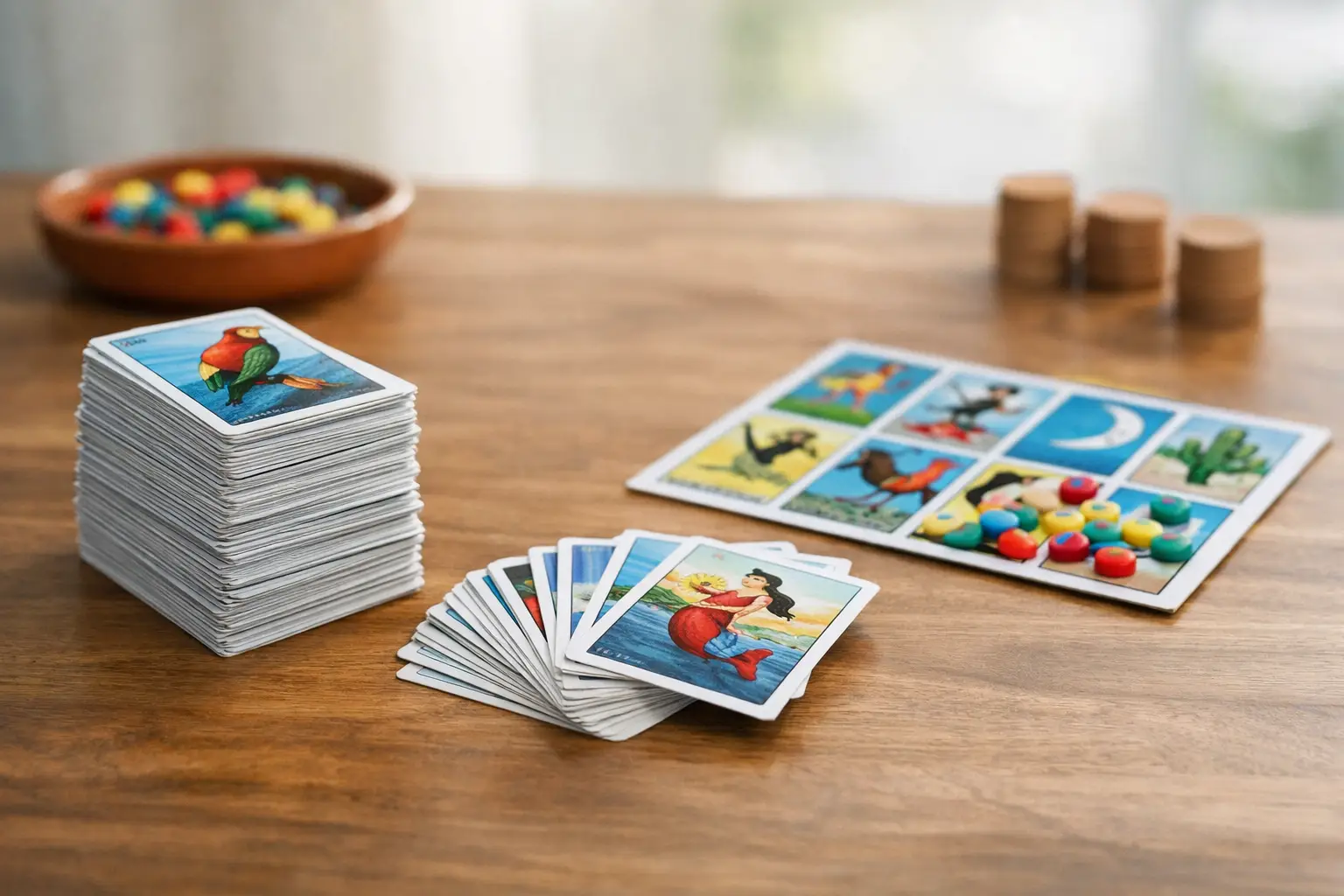
A great custom game starts with a question that sounds simple: what lotería deck size will make your people, memories, and inside jokes feel like a complete game? The answer is not always more cards. A deck for a wedding welcome party has different needs than one for a classroom, family reunion, or brand pop-up. The right size gives every card a moment, keeps the caller moving, and makes your finished game feel intentional from the first draw.
The traditional lotería deck size is 54 cards
Classic Mexican Lotería is traditionally played with a deck of 54 illustrated cards. Each card carries a distinct image and name, from familiar figures and objects to playful symbols that players recognize at a glance. A caller draws cards one at a time, and players mark matching images on their tablas, or game boards.
That 54-card format is a strong reference point for a reason. It creates enough variety for repeat play, gives a game satisfying suspense, and supports multiple unique boards without making the deck feel endless. When you are creating a personalized deck, 54 cards can also be a wonderful storytelling canvas: 54 relatives, favorite foods, memorable places, shared sayings, pets, traditions, or event moments.
Still, traditional does not have to mean mandatory. A custom deck can be smaller when your goal is a quick, focused game or when you have a very specific story to tell. It can also be built around a larger collection of ideas when you want more variety. The best number depends on how, where, and with whom you plan to play.
How to choose your lotería deck size
Start with the experience you want guests to have. Think about the length of the game, the number of images you can personalize well, and whether people will play once or return for several rounds. A meaningful card is more valuable than a card added only to reach a number.
A smaller deck works beautifully for a short activity, a younger group, or an event where Lotería is one part of a busy schedule. With fewer cards, players see their favorites more often and the caller can finish a round quickly. The trade-off is repetition. If guests play several rounds, they may begin to notice the same combinations and outcomes.
A larger deck creates more surprise and a richer visual world. It is especially fitting for big celebrations, community groups, or a custom deck designed to become a keepsake. More cards let you represent more people and details, but they also ask more from your planning. Every image needs to be recognizable, every card name needs to be easy to call, and the complete set needs to feel cohesive.
Choose 54 cards for a full, classic-feeling game
A 54-card deck is a natural choice if you want the familiar rhythm of traditional Lotería with a personal twist. It is large enough to make every round feel different while remaining manageable to organize, print, shuffle, and store.
This size works well for weddings, reunions, holiday gatherings, milestone birthdays, and custom gifts. You might use it to feature 54 favorite family characters, couple memories, hometown references, or phrases your group says all the time. For a business or community organization, the same format can spotlight products, team personalities, neighborhood landmarks, and values without feeling like a brochure.
The key is balance. Mix portraits with objects, places, funny moments, and symbols. If every card is a face, players may have trouble recognizing the cards quickly from across a table. A deck with visual variety is easier to play and more fun to admire.
Choose a smaller deck for a quick, focused moment
A deck of roughly 16 to 36 cards can be ideal when time is limited or your concept is tightly curated. A baby shower might center on the parents-to-be, family members, and playful baby-themed images. A classroom deck may feature vocabulary, local history, or student-created characters. A party game with a short card set can deliver big laughs without taking over the whole event.
Smaller decks are also practical when you are working with a limited photo collection. Rather than stretching a handful of images into repetitive variations, choose the strongest photos and give each one a clear identity. Upload your favorites, cartoonify them, customize the card text, and build a polished set around what matters most.
Keep the boards in mind, though. If the deck becomes very small, a full 4-by-4 game board may fill too quickly. You may want a smaller board layout or a winning pattern that asks players to complete a line, corners, or a special shape. Matching game rules to your card count keeps the pace lively.
Choose a larger deck when replay value matters most
A deck larger than 54 cards can make sense for an ongoing activity, a classroom resource used throughout the year, or a commercial project with a broad theme. More cards mean more possible combinations, more room for detailed categories, and more reasons for players to come back.
But bigger is not automatically better. A larger deck can lengthen each round and increase the work needed to create distinct boards. It also needs a clear system. Consider grouping your cards by category before you build: people, places, foods, traditions, sayings, and surprise cards. If one category overwhelms the others, the game can feel less varied than the total count suggests.
For event use, ask whether guests will actually have time for that variety. A 70-card deck may be perfect for a game night. At a reception where guests are drifting between dinner, photos, and dancing, a classic or compact deck is often the better fit.
Your game boards affect the size decision
Deck size and board design work together. In a traditional setup, each player receives a tabla with 16 images in a 4-by-4 grid. The deck contains more cards than any one board, so no player can predict what will be called next. That uncertainty is where the cheers, near-wins, and dramatic final card come from.
When you make a personalized game, avoid placing every deck card on every board. Boards should have overlapping cards, but each one should still feel different. If everyone has identical boards, the game ends in a tie. If the boards barely share any cards, some players may wait too long to mark anything.
For a small gathering, plan enough different boards so each guest or team gets a distinct layout. For a larger event, you can repeat boards if needed, especially when people play in groups. Just be transparent about whether duplicate boards mean shared winners. The right approach depends on whether you want a casual icebreaker or a competitive game with prizes.
Build a card count around real photos and clear calls
Personalization is what makes a custom Lotería deck memorable, but clarity makes it playable. Before deciding on your final count, gather more ideas than you think you need. Look through photo albums, group chats, event details, favorite foods, nicknames, travel memories, and phrases that instantly belong to your group.
Then narrow the collection with a simple test: can a caller announce this card clearly, and can players recognize it in a second or two? A card called The Cousin in Sunglasses may be funny to everyone at the reunion. A vague image or overly long label may slow down the game. Short, punchy names make the experience smoother and give your caller room to add personality.
Photo quality matters, too. Choose images where the subject is visible and well lit, especially for cards featuring people. A cartoon-style transformation can bring a unified look to photos taken at different times and places, while custom text gives each image its own Lotería-style identity. That means a deck can feel artistically connected even when it includes a childhood photo, a recent selfie, and a picture of somebody's legendary tamales.
Plan for printing, shuffling, and sharing
The physical feel of the game deserves consideration. More cards create a thicker stack to shuffle and a larger set to package, while smaller decks are easy to pass around and play almost anywhere. If you are printing for a crowd, your board quantity may matter more to your budget and preparation than a few additional cards in the deck.
Make your deck count early, then let it guide the rest of the project: card names, board variations, game length, and print files. Modern Lotería Studio makes that workflow feel approachable by bringing photo personalization, editable card text, and print-ready game materials into one creative space.
Choose the number that serves the people around the table. Whether your deck holds 24 beloved moments or a full 54-card cast of characters, the best size is the one that gets everyone laughing, calling out, and asking for one more round.