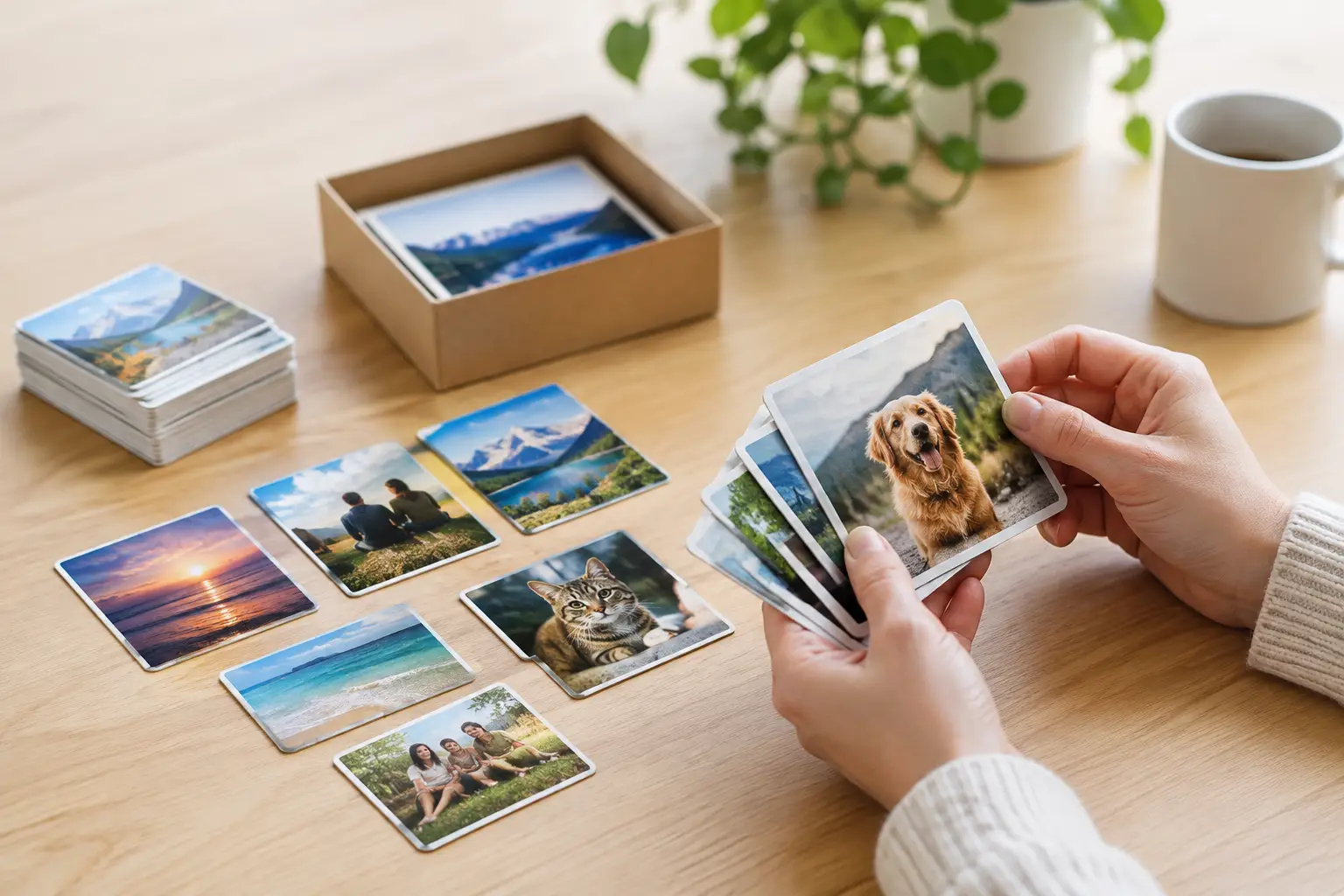
A great custom game deck gets people laughing before the first card is called. Your cousin becomes the card everyone hopes to draw. Your wedding party gets a new kind of introduction. That one family dog with the unforgettable expression earns a place beside the legends. Learning how to build a photo game deck is really about turning familiar faces, shared jokes, and favorite memories into something people can play together.
For a personalized Lotería-inspired deck, the best results come from making a few thoughtful decisions early. You do not need illustration skills or a complicated design background. You need a clear reason for the deck, photos with personality, and enough structure to make every card feel like it belongs in the same game.
Start With the Moment You Want to Celebrate
Before uploading a single image, decide what your deck is meant to remember. A birthday deck can be loud, funny, and full of the guest of honor's biggest catchphrases. A wedding deck might spotlight the couple, their families, favorite places, and the small details that shaped the day. A reunion deck can bring generations together through beloved relatives, hometown references, and dishes everyone recognizes.
This choice becomes your creative filter. If a photo is funny but has nothing to do with the event or group, it may be better saved for another project. A deck feels more meaningful when the cards tell one connected story rather than acting like a random camera roll.
Think about the people who will play, too. A deck for close friends can lean into inside jokes. One for a school fundraiser or community event should use references more people can recognize. There is room for both humor and heart, but the balance depends on the room.
Choose Photos With Clear Personality
The strongest card images are not always the most polished portraits. Look for photos where the subject has an expressive face, a recognizable outfit, a favorite prop, or a pose that instantly feels like them. Someone holding their famous grill tongs may make a better card than a formal headshot. Your aunt mid-dance, your child in a superhero cape, or your friend with their beloved cafecito can all become memorable game moments.
Give yourself more choices than you think you need. As you review images, set aside a few backups for people whose first photo is blurry, heavily shadowed, or crowded with other faces. Photos taken in natural light generally work well, especially when the main subject is easy to see.
Try to vary the composition across the deck. If every card is a close-up selfie, the finished set can feel visually flat. Mix faces with full-body poses, pets, objects, food, locations, and meaningful symbols. A personal deck becomes more playful when not every card is a person.
If you are creating a deck around a large family or event, be intentional about representation. You may not be able to include every guest, but you can make room for shared traditions and recognizable details that help everyone feel part of the game.
Give Every Card a Name Worth Calling Out
The card title does more than label an image. It gives the caller a line to deliver and gives players a clue to listen for. A good title can be sincere, funny, bilingual, traditional, or totally unexpected, as long as it matches the tone of the deck.
You might name a card after the person in the photo, such as “La Tía Rosa,” or turn their personality into the title, such as “El Rey del Asador.” For a baby shower, a tiny sneaker could become “Los Zapaticos.” For a graduation party, a photo of late-night study snacks might become “El Cafecito.” Keep titles short enough to read easily at a glance and distinct enough that players do not confuse them.
This is also where your cultural references can shine. Spanish, English, and Spanglish can all work beautifully in the same deck when they reflect the way your group actually speaks. Do not force a language choice that feels less personal than the real conversations around your table.
How to Build a Photo Game Deck With a Playable Mix
A deck is more fun when it has rhythm. That means combining obvious crowd-pleasers with smaller details people discover as the game goes on. Start by choosing the essential people, then fill out the collection with places, traditions, foods, hobbies, pets, and objects that make your story complete.
For example, a wedding deck might include the couple, parents, wedding party, the venue, the proposal spot, a favorite cocktail, the getaway car, and the song that always gets everyone on the dance floor. A family reunion deck could feature grandparents, cousins, the domino table, the backyard, the family recipe, and the relative known for arriving late.
Avoid making cards too visually similar. Two nearly identical photos of the same person can make game boards harder to scan. Instead, give repeated subjects different roles. Your brother can appear once as “El Hermano” and later as “El DJ” only if the images and titles create clearly different moments.
It also helps to plan for scale. A small gathering may only need a compact set of cards and a few game boards. A larger event needs enough variety that multiple boards feel different and winners are not called at the exact same moment every round. If you expect several tables of players, build with board variety in mind from the beginning.
Modern Lotería Studio keeps this workflow focused: upload your photos, cartoonify them into a cohesive visual style, customize the text, and generate coordinated cards and game boards. The goal is not to make you act like a production designer. It is to help your ideas arrive as a polished, playable set.
Create One Visual World for the Deck
Photo-based cards can feel surprisingly cohesive when they share a consistent treatment. Cartoon-style artwork is especially useful here because it transforms photos taken in different places and lighting into a collection with one recognizable look. It can make a casual phone photo feel at home beside a carefully posed picture.
Choose a theme that supports the occasion without competing with the photos. Bright celebratory color can work for birthdays and fiestas. Softer tones may fit a wedding, anniversary, or baby shower. A brand or organization may prefer colors that echo its existing identity. The key is contrast: titles should remain easy to read, and images should stay the center of attention.
Leave room for personality rather than chasing perfection. The slightly silly photo, the old family snapshot, or the imperfectly timed expression may become the card people remember most. Professional-looking output does not have to mean overly formal.
Build Game Boards That Invite Everyone In
Cards tell the story, but game boards create the shared experience. Each board should use a different arrangement of cards so players have their own path to a win. When the same few images appear together on every board, the game becomes predictable quickly.
Consider how your group will play. For a fast, high-energy party, a smaller board can keep rounds moving. For a seated family gathering, a fuller board creates more suspense and gives the caller time to add commentary. You can also decide in advance whether players will win with a line, a pattern, four corners, or a full board.
Make the calling part part of the entertainment. Invite a funny relative to call the cards, or rotate callers between rounds. A card title can be announced straight, turned into a clue, or paired with a memory. Just make sure the caller uses the exact card name often enough that every player can follow along.
Check the Details Before You Print
A quick review protects the fun. Read every title out loud, check spellings of names and nicknames, and make sure no two card names are too close. Review the photo crop on each card so faces, meaningful props, and important details are not cut off.
Then think practically about the event. Decide how many decks and boards you need, whether guests will mark boards with beans or tokens, and who will handle the cards during play. Print-ready files make production simpler, but it is still wise to order or print early enough to review a physical sample if the event is especially important.
Your deck does not need to capture every memory to feel complete. Choose the moments that make people smile, let the images carry their history, and put the finished game where people can gather around it. The best card in the deck may be the one that starts a story nobody expected to tell.